

NEMT stands for Non-Emergency Medical Transportation. An NEMT business transports people to and from medical appointments when they do not need an ambulance but cannot safely, conveniently, or reliably transport themselves.
Your passengers may include older adults, Medicaid beneficiaries, wheelchair users, dialysis patients, people attending physical therapy, rehabilitation patients, behavioral health patients, people attending chemotherapy, nursing-home residents, and individuals being discharged from hospitals.
The key words are non-emergency. If someone is experiencing a heart attack, severe breathing difficulty, uncontrolled bleeding, stroke symptoms, or another medical emergency, that person needs emergency medical services rather than an ordinary NEMT vehicle.

An NEMT driver generally does not diagnose patients or provide emergency medical treatment.
Your job is transportation, passenger assistance within the permitted scope of your service, documentation, safety, punctuality, and getting passengers to the correct healthcare destination.
You can make money from Medicaid transportation contracts, transportation brokers, managed-care plans, hospitals, dialysis centers, rehabilitation facilities, skilled nursing facilities, assisted-living communities, workers’ compensation cases, private-pay customers, and healthcare organizations.

This sounds simple until you look at the compliance side. NEMT is not the kind of business where you should buy an old minivan, put your telephone number on the side, and start transporting vulnerable passengers the following morning.
Your state may require provider enrollment, vehicle inspections, special operating authority, commercial insurance, driver background screening, motor vehicle record checks, wheelchair securement training, passenger-assistance training, drug policies, broker credentialing, and detailed trip documentation.
Insurance can also be expensive. A wheelchair-accessible vehicle may cost considerably more to purchase and insure than an ordinary passenger car. The business can nevertheless be attractive because demand is recurring.
- A dialysis customer may need transportation three times every week.
- A rehabilitation patient may travel several times per week for months.
- A skilled nursing facility may need dozens of transportation trips every month.
This repeat demand is one of the biggest reasons NEMT can become a scalable transportation business.
The biggest beginner mistake is buying vehicles before understanding who will provide the trips.
A $70,000 wheelchair-accessible van sitting in a parking lot does not generate revenue.
Before purchasing a fleet, you need to understand your state’s Medicaid system, broker network, facility demand, private-pay opportunities, reimbursement rates, insurance requirements, and how many trips you realistically expect to obtain.
Steps on How to Start a NEMT Business
-
Conduct Market Research
Your NEMT market research should begin with healthcare facilities rather than with vehicle dealerships.
Map the medical destinations inside the territory you intend to serve. Look for:
- Dialysis centers
- Hospitals
- Skilled nursing facilities
- Assisted-living communities
- Rehabilitation centers
- Physical therapy clinics
- Behavioral health facilities
- Cancer treatment centers
- Adult day programs
- Outpatient surgery centers
- Primary care practices
- Specialist medical centers.
Do not merely count them. Talk to their discharge planners, social workers, transportation coordinators, case managers, and administrators.
Ask what transportation problems they experience. You may learn that patients regularly wait 90 minutes for return transportation after dialysis.
- A nursing facility may struggle to find wheelchair vans for early morning appointments.
- A hospital may need reliable discharge transportation during evenings.
- A rehabilitation facility may need recurring trips for the same group of clients.
Those problems are potential business opportunities. You should then identify how Medicaid transportation is administered in your state.
Some states work through statewide or regional NEMT brokers. Others use managed-care organizations, local government entities, or combinations of several systems.
You need to know which organizations actually assign trips in your proposed service area.
Do not assume that obtaining a Medicaid provider number automatically guarantees trip assignments.
A broker may already have enough transportation providers in your county.
Ask whether the network is currently accepting new providers before purchasing several vehicles.
Also investigate private-pay demand. Families sometimes need transportation for older relatives who no longer drive but do not qualify for a government-funded ride.
Private-pay transportation can sometimes produce higher margins than broker work, although you must generate the customer yourself.
Finally, study the distance between medical facilities and residential areas. Empty miles can destroy NEMT profitability.
A vehicle that carries a passenger 12 miles and then travels 25 miles empty before the next pickup is producing significantly less revenue than a well-routed vehicle with tightly grouped trips.
a. Who is the Target Market for a NEMT Business?
- Medicaid beneficiaries
- Older adults
- Wheelchair users
- Dialysis patients
- Rehabilitation patients
- Physical therapy patients
- Behavioral health patients
- Cancer treatment patients
- People attending recurring specialist appointments
- Hospital discharge patients
- Residents of skilled nursing facilities
- Assisted-living residents
- Adult day program participants
- People with mobility limitations
- Managed-care organizations
- Health plans
- Hospitals
- Dialysis centers
- Workers’ compensation administrators
- Private-pay families
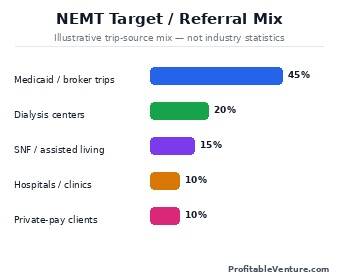
b. Is a NEMT Business Profitable?
Yes, a NEMT business can be profitable, but only when vehicles are utilized consistently and trip rates cover the real cost of providing service.
A common beginner mistake is calculating revenue without calculating vehicle downtime.
Suppose a wheelchair trip pays well. That does not necessarily mean it is profitable if the driver spends:
- 30 minutes traveling to the passenger
- 15 minutes helping the passenger board
- 35 minutes driving to the appointment
- 60 minutes waiting
- 35 minutes returning the passenger
- 25 minutes driving empty to the next assignment.
You need to know the revenue generated per driver hour and per vehicle hour rather than simply looking at the payment attached to one trip. The most profitable operators usually improve:
- Vehicle utilization
- Route density
- On-time performance
- Trip documentation
- Driver productivity
- Recurring facility relationships
- Payer diversification.
A company that depends almost entirely on one Medicaid broker is also exposed to concentration risk.
If that broker reduces rates, changes contracts, stops assigning trips, or loses the state contract, your revenue could fall quickly.
A healthier NEMT company gradually develops a mix of broker trips, healthcare facility contracts, managed-care relationships, and private-pay work.
c. Are There Existing Niches in the NEMT Industry?
Yes. Common NEMT niches include:
- Ambulatory passenger transportation
- Wheelchair transportation
- Bariatric wheelchair transportation
- Dialysis transportation
- Hospital discharge transportation
- Behavioral health transportation
- Physical therapy transportation
- Cancer treatment transportation
- Skilled nursing facility transportation
- Assisted-living transportation
- Senior transportation
- Long-distance medical transportation
- Stretcher or gurney transportation where legally permitted
- Workers’ compensation transportation
- Private-pay medical transportation
- Managed-care transportation.
A beginner should be especially careful with stretcher transportation. Some states regulate stretcher or gurney transportation much more strictly than ordinary wheelchair transportation, and certain passenger conditions may require an ambulance instead.
Do not add stretcher services simply because the trip reimbursement appears attractive.
d. Who are the Major Competitors?
Most direct NEMT competitors will be local transportation companies operating in your service territory.
However, several major organizations influence the NEMT marketplace by managing transportation networks and assigning trips. They include:
- Modivcare
- MTM Health
- Verida
- SafeRide Health
- Regional Medicaid transportation brokers
- Managed-care transportation networks
- Local wheelchair transportation companies
- Taxi and livery companies approved for medical transportation
- Public paratransit systems
- Rideshare providers used by health plans for eligible ambulatory trips.
These national brokers are not necessarily direct competitors in the same way another local NEMT fleet is.
In many states, they can actually become a major source of your trips. This means your competitive strategy has two sides.
You need to compete for contracts and trip allocations from payers while also competing with local transportation providers on safety, reliability, capacity, documentation, and customer service.
e. Are There County, State, or Federal Regulations for a NEMT Business?
Yes. NEMT is more regulated than an ordinary local transportation business.
At the federal Medicaid level, state programs must assure necessary transportation for eligible beneficiaries to and from covered medical providers.
Federal law also establishes minimum safeguards for Medicaid-paid NEMT providers and drivers.
These include mechanisms intended to ensure that transportation providers and drivers are not excluded from federal healthcare programs, that drivers possess valid driver’s licenses, that providers maintain processes dealing with violations of state drug laws, and that driving histories and traffic violations can be disclosed to the state Medicaid program.
Your state can impose significantly more requirements. Depending on location, requirements may include:
- Transportation company license
- Passenger carrier authority
- Medicaid provider enrollment
- NEMT broker credentialing
- Commercial auto insurance
- General liability insurance
- Workers’ compensation insurance
- Vehicle inspections
- Driver background checks
- Motor vehicle record checks
- Drug and alcohol policies
- First aid or CPR training
- Passenger assistance training
- Wheelchair securement training
- Defensive driving training
- Vehicle age or mileage limits
- GPS tracking
- Trip documentation requirements
- Driver identification requirements.
Do not copy another state’s startup checklist. An NEMT company operating legally in Arizona may face different enrollment, vehicle, insurance, and broker requirements from one operating in New York, Georgia, Ohio, or Texas.
ADA obligations also matter. Private transportation companies must not discriminate against passengers because of disability and may have accessibility and equivalent-service obligations depending on vehicle type and transportation system.
f. Does Medicare Pay for NEMT?
Do not build your business plan on the assumption that ordinary Original Medicare will pay for routine NEMT rides.
Original Medicare primarily covers ambulance transportation when specific medical-necessity requirements are satisfied.
Some Medicare Advantage plans may separately offer transportation as a supplemental benefit.
That means a transportation company may obtain work through certain health plans, but you should not advertise ordinary NEMT as though it is automatically covered by Original Medicare.
g. Is There a Franchise for a NEMT Business?
NEMT is predominantly an independent-provider industry. There are transportation, senior-service, and healthcare-support franchise opportunities that may include transportation.
But you do not need a franchise to establish a NEMT company. For many operators, the more important relationships are with:
- Medicaid agencies
- NEMT brokers
- Managed-care organizations
- Dialysis companies
- Hospitals
- Skilled nursing facilities
- Insurance carriers.
If you consider any transportation franchise, confirm that the franchise model is actually approved to provide NEMT in your state rather than simply general senior transportation.
h. What Do You Need to Start a NEMT Business?
- Registered business entity
- Required state and local transportation licenses
- Medicaid provider enrollment where applicable
- Broker contracts or other trip sources
- Commercial auto insurance
- General liability insurance
- Workers’ compensation where required
- Qualified vehicles
- Wheelchair-accessible vehicles if serving wheelchair passengers
- Trained drivers
- Background screening
- Motor vehicle record checks
- Vehicle inspection program
- Wheelchair securement systems
- Dispatch software
- GPS tracking
- Trip documentation system
- Billing system
- Safety policies
- Working capital.
-
Choose a Memorable Business Name
Your business name should communicate safety, reliability, care, transportation, mobility, or access.
Avoid names that imply you operate an ambulance service if you are not licensed to provide ambulance care. Some NEMT business name ideas are:
- CareBridge Medical Transport, LLC
- SafePath Medical Transportation, LLC
- AccessCare Mobility, LLC
- PatientWay Transportation, LLC
- CareRoute NEMT, LLC
- Trusted Ride Medical Transport, LLC
- HealthLink Mobility, LLC
- ComfortWay Medical Transportation, LLC
- CareMiles Transportation, LLC
- Reliable Patient Transport, LLC
- Medical Ride Partners, LLC
- SafeCare Mobility, LLC
- Patient First Transportation, LLC
- HealthRoute Medical Transport, LLC
- AccessPoint NEMT, LLC
- CareLine Transportation, LLC
- Comfort Transit Medical Services, LLC
- WellRide Medical Transport, LLC
- BridgeCare Mobility, LLC
- Dependable Medical Transit, LLC.
Search the state business registry and investigate potential trademark conflicts before ordering vehicle graphics or creating your website.
-
Register Your Business
a. What Type of Business Structure is Best for a NEMT Business?
An LLC is a common structure for a smaller NEMT company. It creates separation between the business and its owners while remaining relatively flexible to operate.
This can be especially useful because an NEMT company faces substantial transportation liability.
A vehicle accident, passenger fall, improper wheelchair securement, employee misconduct, or allegation of unsafe service can create serious financial exposure. An LLC does not replace adequate insurance.
b. Steps to Form an LLC
- Choose an available business name
- File Articles of Organization
- Choose a registered agent
- Create an operating agreement
- Obtain an EIN
- Open a business bank account
- Register for applicable taxes
- Apply for transportation operating authority where required
- Enroll with Medicaid where appropriate
- Complete broker credentialing
- Purchase commercial insurance
- Maintain state annual filings.
c. What Type of License is Needed to Start a NEMT Business?
There is no single national NEMT license that replaces state requirements. You may need:
- General business license
- Passenger transportation license
- Livery or for-hire authority
- NEMT provider license or certification where required
- Medicaid provider enrollment
- Broker credentialing
- Commercial vehicle registration
- Vehicle inspection certification
- Local operating permits
- Employer registrations.
Some transportation activities may also trigger state transportation commission or department-of-motor-vehicles requirements.
d. What Certifications are Needed?
No single voluntary national NEMT certification replaces your state’s legal requirements. However, drivers may need or benefit from:
- CPR certification
- First aid certification
- Defensive driving training
- Wheelchair securement training
- Passenger assistance training
- Bloodborne pathogen awareness
- HIPAA/privacy awareness where applicable
- Mobility device assistance training
- Certified Transport Specialist training
- Broker-specific driver training.
NEMTAC offers industry standards, education, driver certification, and voluntary provider accreditation.
Accreditation can help demonstrate operational maturity, but it does not replace state Medicaid enrollment or transportation licensing.
e. What Documents are Needed?
- Business formation documents
- EIN
- Business license
- Transportation operating authority
- Medicaid enrollment documents
- Broker contracts
- Insurance certificates
- Commercial auto policies
- Vehicle titles and registrations
- Vehicle inspection records
- Driver licenses
- Motor vehicle reports
- Background-check documentation
- Driver training certificates
- Drug-policy documentation
- Wheelchair securement training records
- Vehicle maintenance records
- Trip logs
- Incident reports
- Billing and claims documentation
- Employee files.
f. Do You Need a Trademark, Copyright, or Patent?
You normally do not need a patent. You may trademark your company name, logo, or slogan.
Copyright can protect original website content, training manuals, advertising graphics, photographs, and written operating procedures.
-
Cost Analysis and Budgeting
a. How Much Does It Cost to Start a NEMT Business?
Startup cost depends heavily on vehicle type. An ambulatory-only company using a used sedan can start significantly cheaper than a wheelchair transportation company using newly converted accessible vans.
However, starting too cheaply can become expensive if the vehicle does not meet broker specifications or cannot serve the passenger types needed to win contracts. For a reasonably prepared operation, you might plan approximately:
- Small one-vehicle NEMT business: approximately $85,000
- Medium three-vehicle NEMT operation: approximately $250,000
- Large eight-vehicle NEMT operation: approximately $650,000.
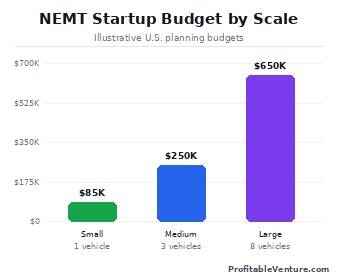
These are planning models rather than fixed requirements. A carefully purchased used vehicle may reduce startup costs substantially, while several brand-new wheelchair vans can push costs much higher.
b. What are the Costs Involved in Starting a NEMT Business?
Small One-Vehicle NEMT Business – Approximately $85,000
- Used or moderately priced wheelchair-accessible vehicle – $40,000
- Commercial insurance and initial deposits – $12,000
- Licensing, inspections, enrollment, and training – $5,000
- Dispatch, GPS, cameras, and technology – $3,000
- Safety equipment and vehicle supplies – $3,000
- Website, branding, and initial marketing – $4,000
- Working capital reserve – $18,000
- Estimated Total – $85,000.
Medium Three-Vehicle NEMT Business – Approximately $250,000
- Three vehicles and accessibility conversions – $125,000
- Working capital reserve – $40,000
- Commercial insurance deposits and initial premiums – $30,000
- Licensing, provider enrollment, inspections, and driver training – $15,000
- Dispatch software, GPS tracking, and cameras – $10,000
- Office and dispatch setup – $10,000
- Marketing and contract development – $10,000
- Legal, accounting, safety equipment, and contingency costs – $10,000
- Estimated Total – $250,000.
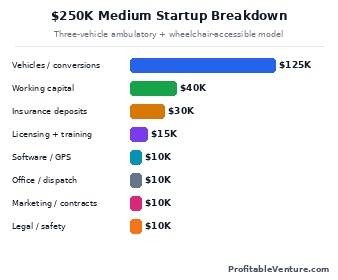
This is the financial model used later in the article.
Large Eight-Vehicle NEMT Business – Approximately $650,000
- Eight-vehicle mixed fleet – $380,000
- Commercial insurance – $80,000
- Working capital and payroll reserve – $100,000
- Dispatch, fleet-management, GPS, and communications technology – $25,000
- Office and dispatch center – $20,000
- Licensing, inspections, enrollment, and driver training – $15,000
- Marketing and contract development – $15,000
- Legal, accounting, safety, and contingency expenses – $15,000
- Estimated Total – $650,000.
c. What Factors Determine the Cost of Starting a NEMT Business?
- Number of vehicles
- Wheelchair accessibility
- New versus used vehicles
- State licensing requirements
- Insurance premiums
- Driver records
- Passenger type
- Broker requirements
- Vehicle inspections
- Training requirements
- Technology
- Working capital
- Payroll reserve
- Service territory.
d. Do You Need to Build a Facility?
No. A small NEMT company can operate from a modest office or approved home administrative location if local rules allow it.
You mainly need secure vehicle parking, dispatch capability, record storage, and an area where vehicles can be inspected, cleaned, and prepared.
As the fleet grows, a commercial yard or office becomes more useful. Look for a facility with:
- Secure vehicle parking
- Easy highway access
- Driver check-in area
- Dispatch office
- Vehicle-cleaning area
- Equipment storage
- Space for driver training
- Security cameras.
e. What are the Ongoing Expenses of a NEMT Business?
- Driver wages
- Payroll taxes
- Commercial auto insurance
- General liability insurance
- Workers’ compensation
- Vehicle payments
- Fuel
- Tolls
- Vehicle maintenance
- Tires
- Wheelchair lift maintenance
- Securement equipment replacement
- Dispatch software
- GPS tracking
- Mobile phones
- Background checks
- Driver training
- Licensing and inspection renewals
- Office costs
- Billing and accounting
- Marketing.
f. What is the Average Salary of Your Staff?
Compensation varies significantly by city and responsibility. For budgeting purposes, a growing NEMT company may plan roughly:
- NEMT Driver: $35,000 – $50,000 annually
- Experienced Wheelchair Transport Driver: $40,000 – $55,000
- Dispatcher: $38,000 – $55,000
- Fleet Supervisor: $50,000 – $70,000
- Operations Manager: $60,000 – $90,000
- Billing/Claims Specialist: $40,000 – $60,000
- Administrative Assistant: $35,000 – $50,000.
These are planning ranges rather than fixed national wage rates.
g. How Do You Get Funding to Start a NEMT Business?
- Personal savings
- SBA-backed business loans
- Commercial vehicle financing
- Equipment financing
- Business lines of credit
- Private investors
- Business partners
- Family financing
- Fleet leasing
- Starting with one vehicle and reinvesting profits.
Working capital deserves particular attention. You may have to pay drivers, fuel, insurance, vehicle payments, and maintenance while Medicaid or broker credentialing is still being completed or while submitted claims are being processed. Do not spend every available dollar on vehicles.
a. Executive Summary
CareBridge Medical Transport, LLC is a proposed non-emergency medical transportation company serving Columbus, Ohio, and surrounding communities.
The company will provide scheduled ambulatory and wheelchair-accessible transportation for individuals who need reliable transportation to medical appointments but do not require an ambulance.
CareBridge Medical Transport will initially operate three vehicles consisting of a mix of ambulatory and wheelchair-accessible capacity.
The company will target Medicaid broker work, dialysis centers, skilled nursing facilities, assisted-living communities, hospitals, rehabilitation centers, managed-care plans, and private-pay customers.
The business will launch with approximately $250,000 in capital. Management will prioritize compliance, vehicle safety, on-time performance, accurate documentation, driver training, clean vehicles, passenger dignity, and route efficiency.
The company will avoid dependence on a single payer by gradually developing multiple broker, facility, and private-pay relationships.
The long-term objective is to build a fleet capable of providing dependable recurring transportation throughout the metropolitan area while maintaining strong utilization and compliance standards.
b. Products and Services
CareBridge Medical Transport, LLC will offer:
- Ambulatory medical transportation
- Wheelchair transportation
- Dialysis transportation
- Physical therapy transportation
- Rehabilitation transportation
- Behavioral health transportation
- Hospital discharge transportation
- Skilled nursing facility transportation
- Assisted-living transportation
- Medical appointment transportation
- Private-pay transportation
- Long-distance medical trips where economically practical
- Recurring facility transportation contracts.
c. Mission Statement
“At CareBridge Medical Transport, LLC, our mission is to provide safe, reliable, respectful, and punctual non-emergency transportation that helps passengers reach essential healthcare while preserving their dignity, comfort, and independence.”
Vision Statement
“Our vision is to build CareBridge Medical Transport into one of the region’s most dependable NEMT providers, recognized by passengers, healthcare facilities, brokers, and health plans for safety, compliance, compassion, and consistent service.”
d. Goals and Objectives
The first goal is to keep the initial three vehicles productive without sacrificing service quality. Management will measure:
- Trips per vehicle per day
- Revenue per vehicle
- Revenue per driver hour
- Empty miles
- On-time pickup rate
- Passenger complaints
- Trip denials
- Rejected claims
- Vehicle downtime
- Driver turnover.
The company will also pursue recurring dialysis and facility work because predictable schedules make routing easier.
Another major goal is payer diversification. Management will avoid allowing one broker or facility to become responsible for almost all company revenue.
Long-term goals include expanding wheelchair capacity, adding facility contracts, developing managed-care relationships, and adding vehicles only after existing vehicles demonstrate sustainable utilization.
e. Organizational Structure
- Owner/General Manager
- Operations Manager
- Dispatcher
- NEMT Drivers
- Wheelchair Transport Drivers
- Fleet Supervisor
- Compliance Coordinator
- Billing/Claims Specialist
- Customer Service Representative
- Bookkeeper/Accountant.
Marketing Plan
a. SWOT Analysis
Strengths
Medical appointments create recurring transportation needs. Dialysis and rehabilitation can produce predictable weekly schedules.
A well-run company can also develop relationships with several healthcare facilities, creating recurring rather than purely walk-in business.
Weaknesses
NEMT requires substantial insurance, compliance, and vehicle investment. Vehicles only earn money while providing productive trips.
A breakdown can remove a large percentage of a small company’s earning capacity immediately. Broker rates may also leave limited room for operational mistakes.
Opportunities
Opportunities include growing senior populations, dialysis demand, rehabilitation, managed-care transportation, hospital discharges, wheelchair transportation, facility contracts, and private-pay senior transportation.
Threats
Threats include rising insurance premiums, vehicle accidents, driver shortages, Medicaid contract changes, broker rate pressure, fuel increases, claim denials, compliance violations, fraud allegations, and losing major facility contracts.
b. How Do NEMT Businesses Make Money?
- Medicaid broker trips
- Managed-care transportation contracts
- Dialysis contracts
- Skilled nursing facility contracts
- Hospital transportation agreements
- Assisted-living transportation
- Private-pay rides
- Workers’ compensation transportation
- Wheelchair transportation
- Long-distance trips
- After-hours services where contracts allow them
- Waiting-time charges where permitted.
Do not assume you can set the price for every trip. Medicaid brokers and health-plan contracts frequently use predetermined or negotiated rate schedules. Private-pay pricing gives you more control.
c. Payment Options
- Broker claims payments
- Medicaid reimbursements where applicable
- Managed-care payments
- Facility invoices
- ACH transfers
- Credit cards
- Debit cards
- Private-pay online billing
- Workers’ compensation invoices.
d. Sales and Advertising Strategies
- Apply to appropriate NEMT broker networks
- Meet dialysis center administrators
- Contact skilled nursing facilities
- Contact hospital discharge planners
- Meet assisted-living administrators
- Develop relationships with rehabilitation centers
- Market private-pay transportation to families
- Create a professional website
- Set up a Google Business Profile
- Develop healthcare facility brochures
- Respond to transportation RFPs
- Network with case managers
- Contact managed-care organizations
- Maintain strong broker performance scores
- Ask facilities for recurring route opportunities.
Your best advertisement is often operational performance. A facility that repeatedly sees your driver arrive five minutes early, assist passengers respectfully, maintain a clean vehicle, and communicate immediately when something changes is more likely to trust you with additional trips.
Financial Projection
a. How Much Should You Charge for NEMT Services?
There is no universal NEMT price list. Medicaid and broker rates are often established contractually.
Private-pay rates can be structured using a base pickup fee, mileage, passenger type, waiting time, and after-hours charges. Illustrative private-pay planning rates might include:
- Ambulatory trip: $35 to $60 base charge plus mileage
- Wheelchair trip: $50 to $90 base charge plus mileage
- Wheelchair mileage: approximately $3 to $5 per loaded mile in some markets
- Ambulatory mileage: approximately $2 to $4 per loaded mile in some markets
- Waiting time: charged separately where permitted
- After-hours service: premium rate where permitted.
These are examples for financial planning only. Actual rates can differ dramatically by city and payer. You should calculate your minimum acceptable rate using:
Required Trip Revenue = Driver Cost + Vehicle Cost + Fuel + Insurance Allocation + Dispatch/Admin Allocation + Expected Empty Mileage + Desired Profit.
b. How Much Revenue Can a NEMT Business Generate?
Revenue depends on fleet size, utilization, service type, reimbursement rates, trip distance, and contracts. For planning purposes:
- One-vehicle operation: approximately $80,000 to $160,000 annual gross revenue
- Three- to four-vehicle operation: approximately $300,000 to $550,000
- Eight- to ten-vehicle operation: approximately $700,000 to $1.5 million or more.
These are planning ranges rather than guaranteed industry averages. The model below uses the $250,000 three-vehicle NEMT company and assumes approximately $390,000 in Year 1 revenue.
c. Five-Year Revenue and Profit Projection
| Fiscal Year | Revenue | Total Expenses | Net Profit | Net Margin |
|---|---|---|---|---|
| Year 1 | $390,000 | $354,000 | $36,000 | 9.2% |
| Year 2 | $470,000 | $421,000 | $49,000 | 10.4% |
| Year 3 | $560,000 | $493,000 | $67,000 | 12.0% |
| Year 4 | $650,000 | $564,000 | $86,000 | 13.2% |
| Year 5 | $760,000 | $641,000 | $119,000 | 15.7% |
Under this model, cumulative five-year revenue would be approximately $2.83 million, while cumulative projected net profit would be approximately $357,000.
The improving margin assumes better routing, stronger recurring facility accounts, improved vehicle utilization, and carefully adding capacity only when trip demand supports it.
d. Sample Five-Year Profit and Loss Projection
| Item | Year 1 | Year 2 | Year 3 | Year 4 | Year 5 |
|---|---|---|---|---|---|
| Revenue | $390,000 | $470,000 | $560,000 | $650,000 | $760,000 |
| Driver Wages and Payroll | $145,000 | $175,000 | $210,000 | $245,000 | $280,000 |
| Fuel and Tolls | $52,000 | $62,000 | $72,000 | $82,000 | $95,000 |
| Insurance | $36,000 | $38,000 | $42,000 | $46,000 | $50,000 |
| Vehicle Payments / Depreciation | $48,000 | $54,000 | $62,000 | $70,000 | $75,000 |
| Maintenance and Tires | $20,000 | $24,000 | $30,000 | $35,000 | $42,000 |
| Dispatch, GPS and Software | $10,000 | $12,000 | $14,000 | $16,000 | $18,000 |
| Licensing, Training and Compliance | $8,000 | $9,000 | $10,000 | $11,000 | $12,000 |
| Administration and Marketing | $18,000 | $22,000 | $26,000 | $30,000 | $34,000 |
| Other Operating Expenses | $17,000 | $25,000 | $27,000 | $29,000 | $35,000 |
| Total Expenses | $354,000 | $421,000 | $493,000 | $564,000 | $641,000 |
| Projected Net Profit | $36,000 | $49,000 | $67,000 | $86,000 | $119,000 |
e. How Much Profit Do NEMT Business Owners Make a Year?
There is no standard owner income. A one-vehicle owner who personally drives may effectively earn both driver compensation and business profit.
A larger operator may generate much higher revenue but must support drivers, dispatchers, managers, insurance, vehicle financing, and administrative staff.
Using the medium-scale model above, projected business profit rises from approximately $36,000 in Year 1 to approximately $119,000 in Year 5.
The owner’s actual personal income will depend on salary, distributions, debt payments, taxes, and reinvestment.
f. What Factors Determine the Amount of Profit?
- Trips per vehicle per day
- Reimbursement rate
- Vehicle utilization
- Empty mileage
- Driver wages
- Insurance costs
- Fuel
- Wheelchair trip volume
- Facility contracts
- Private-pay customers
- Claim denial rate
- Vehicle downtime
- Driver turnover
- Route density
- Broker performance.
g. What is the Profit Margin of a NEMT Business?
Calculate your actual margin using:
Net Profit Margin = Net Profit ÷ Total Revenue × 100.
The medium-scale model in this article starts at approximately 9% and gradually improves toward approximately 16%.
This is an illustrative planning target rather than a guaranteed industry margin.
h. What is the Sales Forecast?
- First Fiscal Year: $390,000
- Second Fiscal Year: $470,000
- Third Fiscal Year: $560,000
- Fourth Fiscal Year: $650,000
- Fifth Fiscal Year: $760,000.
-
Set Up Your Office and Fleet
a. How Do You Choose the Perfect Location?
A NEMT company generally does not need an expensive retail storefront. You need to position your vehicles efficiently relative to trip demand. Look for areas close to clusters of:
- Dialysis centers
- Hospitals
- Nursing facilities
- Rehabilitation centers
- Senior communities
- Medical office districts
- Major highways.
A cheap parking facility 30 miles outside your actual service territory may increase empty mileage enough to wipe out the rent savings.
b. What State and City is Best to Start a NEMT Business?
There is no universally best city because Medicaid broker networks, provider shortages, reimbursement rates, insurance, and state licensing requirements vary. Metropolitan areas worth researching can include:
- Dallas-Fort Worth, Texas
- Houston, Texas
- Atlanta, Georgia
- Columbus, Ohio
- Indianapolis, Indiana
- Charlotte, North Carolina
- Phoenix, Arizona
- Orlando, Florida
- Tampa, Florida
- Las Vegas, Nevada.
However, do not choose a city based only on population. Call the relevant state Medicaid agency and transportation brokers first.
A smaller market with a shortage of dependable wheelchair providers may offer a better opportunity than a huge city with an oversaturated broker network.
c. What Equipment is Needed to Operate a NEMT Business?
- Wheelchair-accessible vans where applicable
- Ambulatory passenger vehicles
- Approved ramps or wheelchair lifts
- Wheelchair securement systems
- Occupant restraint systems
- First aid kit
- Fire extinguisher
- Reflective emergency triangles
- Spill and cleaning kit
- Hand sanitizer and cleaning supplies
- GPS tracking
- Dash cameras where permitted
- Driver smartphones or tablets
- Dispatch software
- Billing software
- Vehicle inspection checklists
- Passenger step stool where appropriate
- Vehicle identification and required markings.
Wheelchair conversions and securement equipment should be designed and installed for passenger transportation rather than improvised by the operator.
-
Hire Employees
NEMT drivers are not ordinary delivery drivers. They regularly work with older adults, people with disabilities, medically fragile passengers, wheelchair users, and people who may be anxious or confused. Hire carefully. Your screening program may include:
- Valid driver’s license verification
- Motor vehicle record check
- Criminal background check
- Federal exclusion screening where required
- Drug screening where required
- Reference checks
- Driving evaluation
- Passenger assistance training
- Wheelchair securement training
- First aid and CPR
- Defensive driving
- Customer service training.
Drivers should understand that punctuality is not simply a customer-service issue.
A passenger who arrives late for dialysis, chemotherapy, surgery, or another critical appointment may have genuine health consequences. Train drivers to inspect their vehicles before the first trip.
The inspection should include tires, lights, mirrors, brakes, wheelchair equipment, securement straps, ramp or lift operation, safety equipment, vehicle cleanliness, and fuel level.
You should also have a policy covering what happens if a wheelchair lift fails while a passenger is scheduled for pickup.
“Sorry, the van is broken” is not an adequate operating system.
As the business grows, develop backup vehicles and backup drivers.
-
Launch the Business Proper
You do not need a grand-opening party. Your real launch begins when your first passenger trusts you to get him or her to an appointment safely and on time. Before accepting a full schedule, test your operation.
- Run sample routes.
- Practice boarding wheelchair passengers.
- Test dispatch notifications.
- Confirm GPS records.
- Test your billing workflow.
Make sure drivers know how to document arrival time, pickup time, mileage, passenger identity, destination, and completion of the trip.
Trip documentation deserves particular attention. NEMT is vulnerable to fraud and billing abuse.
- Do not bill for trips that were not completed.
- Do not inflate mileage.
- Do not duplicate claims.
- Do not falsify passenger signatures or trip verification.
- Do not bill wheelchair rates for an ambulatory trip unless the payer’s contract genuinely authorizes it.
Strong records protect the business during broker reviews, payer audits, and complaints.
a. What Makes a NEMT Business Successful?
- On-time performance – Medical appointments are time-sensitive.
- Driver quality – Drivers are the public face of the business.
- Vehicle reliability – A broken vehicle cannot produce revenue.
- Proper wheelchair securement – Passenger safety comes first.
- Route efficiency – Empty miles reduce profit.
- Accurate documentation – Payment depends on proving trips correctly.
- Clean claims – Rejected claims interrupt cash flow.
- Strong contracts – Recurring facilities stabilize the schedule.
- Payer diversification – Avoid depending on one broker.
- Compliance – Shortcuts can destroy an otherwise profitable company.
- Working capital – Expenses arrive before some reimbursements do.
b. What Happens During a Typical Day at a NEMT Business?
A typical day may begin around 4:30 or 5:00 a.m. if dialysis transportation is part of your business.
- The dispatcher reviews the day’s schedule and confirms that every vehicle and driver is available.
- Drivers complete pre-trip vehicle inspections.
- The first driver may collect a wheelchair passenger at 5:30 a.m. and transport the passenger to dialysis.
- Another driver may take two ambulatory passengers to separate rehabilitation appointments.
- The dispatch system tracks vehicles and appointment times throughout the day.
If an appointment runs late, the dispatcher may need to rearrange the return trip without delaying three other passengers.
- A hospital may call asking whether you can provide a same-day discharge trip.
- A nursing facility may need a wheelchair vehicle for a specialist appointment.
Meanwhile, the billing team verifies completed trips and checks documentation before claims are submitted.
Drivers refuel, clean vehicles, report incidents, and record mechanical problems. At the end of the day, management reviews:
- Completed trips
- Cancellations
- No-shows
- Late pickups
- Vehicle mileage
- Fuel consumption
- Complaints
- Claim documentation
- Vehicle maintenance needs
- The next day’s schedule.
c. What Skills and Experience Do You Need to Build a NEMT Business?
- Transportation management – Routing determines profitability.
- Customer service – Passengers may be vulnerable or anxious.
- Compliance management – Requirements cannot be treated casually.
- Driver management – Reliability begins with employees.
- Financial management – Revenue and cash flow are not the same thing.
- Claims management – Poor documentation can turn completed trips into unpaid work.
- Fleet management – Vehicles need preventive maintenance.
- Scheduling – Medical appointment times create complicated routing.
- Sales – Facility relationships help diversify revenue.
- Problem solving – Cancellations and delays happen daily.
You do not need to have operated an ambulance company before starting NEMT.
However, this is one business where a beginner should spend more time understanding compliance than designing a logo.
Before purchasing several vehicles, contact the Medicaid agency in the state where you intend to operate.
- Find out how transportation is administered.
- Identify the relevant brokers.
- Confirm whether their provider networks are accepting applications.
- Obtain actual insurance quotes.
- Ask for their vehicle standards.
- Find out whether wheelchair vans require specific inspections.
- Talk to dialysis centers and nursing facilities.
- Calculate the minimum number of paid trips your vehicle must complete each day.
Then decide whether the economics work. Most importantly, understand what you are really selling.
You are not merely selling a ride from Point A to Point B. You are selling dependable access to healthcare.
If your company can consistently provide safe vehicles, trained drivers, accurate documentation, compassionate service, efficient routing, and punctual pickups while maintaining strict compliance, you can build a successful NEMT business even if you started with no previous medical transportation experience.